



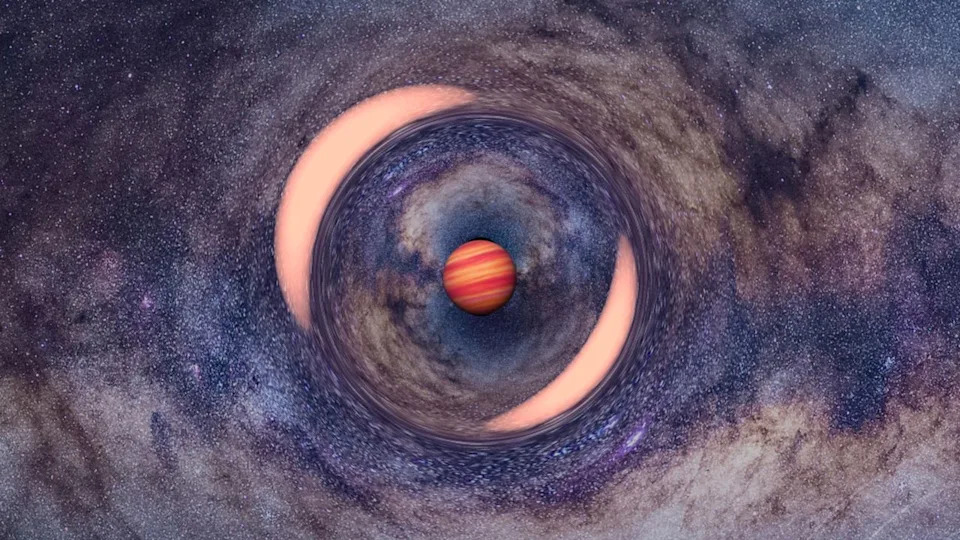
TLDR: Astronomers have discovered a rare free-floating planet smaller than Jupiter, challenging traditional planetary formation theories. Detected using gravitational microlensing, this finding suggests such planets may be more common than previously thought, prompting a reevaluation of planetary definitions and encouraging further exploration of the cosmos.
Astronomers have made a groundbreaking discovery in the field of astrophysics with the detection of a rare free-floating planet. This celestial body, which is not bound to any star, provides significant insights into the formation and evolution of planets in our universe. Such free-floating planets are enigmatic entities that challenge traditional views of planetary formation, typically associated with star systems.
The newly identified planet is notably smaller than Jupiter, raising questions about how it could have formed without the gravitational anchor of a star. Researchers suggest that it may have originated from a protoplanetary disk, the same material that forms stars, but was ejected into space during its formation process. This finding opens up new avenues for understanding how many other free-floating planets might exist in the vast expanses of space.
The process of discovery involved sophisticated techniques utilizing gravitational microlensing, a method that measures the light from distant stars. When the planet passes in front of a distant star, its gravity can magnify the light, allowing scientists to detect its presence. This technique has proven invaluable in uncovering objects that are otherwise difficult to observe.
Moreover, this discovery could significantly impact our understanding of the planetary formation process and the dynamics of planetary systems. It suggests that such planets may be more common than previously thought, possibly outnumbering those associated with stars. This finding could lead to a reevaluation of how we define planets and their roles in the cosmos.
As astronomers continue to study this free-floating planet, they hope to uncover more details about its characteristics and origins. The implications of this discovery extend beyond our solar system and encourage further exploration of the universe. The ongoing research into these mysterious celestial bodies will undoubtedly enrich our understanding of the cosmos and the myriad of celestial phenomena within it.
In conclusion, the detection of a free-floating planet marks a significant advancement in our exploration of space. It highlights the complexity and diversity of planetary systems, encouraging scientists to look deeper into the realms of space exploration and the mysteries that lie beyond our understanding.
Please consider supporting this site, it would mean a lot to us!
